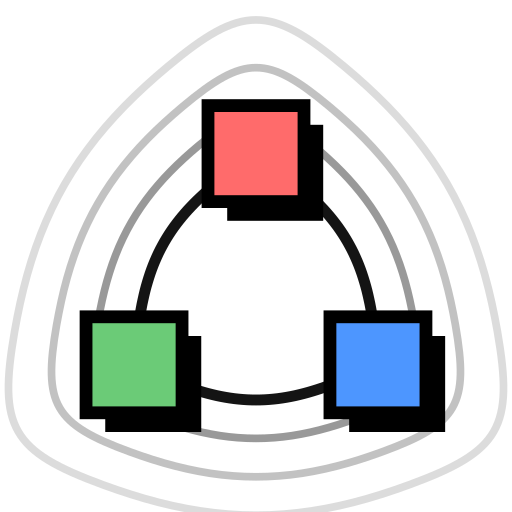
Spatial composition
Music software usually asks when. Vibe Together also asks where. Place Sources, nodes, and wires on a shared grid; distance becomes rhythm, pitch becomes color, and signal motion shows you what the music is doing.
What is different
Most music software asks one excellent question: where does this sound sit on the timeline? Vibe Together asks another: what is this sound connected to? Here, a composition is a place you can move through. Sources create signals, wires carry them, nodes turn them into sound, and the shape of the network changes the result.
Move a node and the groove shifts. Split a signal and the arrangement learns to breathe. Publish the graph and someone else can listen, inspect the structure, then remix it into a new editable vibe. The goal is not to defeat the timeline. Timelines are magnificent. This is another instrument.
That spatial instinct is ancient. Memory-palace techniques pin ideas to imagined rooms because human recall is unusually fond of geography. A music graph gives pitches, rhythms, and transformations similar addresses: you remember where the idea lives.
- Layout becomes timing: distance between nodes is signal travel time, so moving things changes the groove.
- Branches become choices: splitters and gates build arrangements you do not have to sequence note by note.
- The topology is shareable: publish a listenable snapshot, then let someone remix its structure without changing your original.
Music you can see
Every event leaves evidence. Pitch class is hue and octave shifts brightness. Duration and velocity appear in the contextual square border around Vibe and Chord Nodes: longer notes stack more border segments, harder hits draw with more visual weight. Signals cross wires in real time, then nodes flash when sound arrives.
This is not decoration. It is a second language running beside the sound. A composer can spot a chromatic surprise before it lands. A teacher can point to the event instead of interrupting it. A new player can watch rhythm become motion while their ears catch up.
A graph can begin several ways
Start with a blank grid and place objects by hand. Play notes with your computer keyboard or a MIDI controller. Hum a phrase into Sing to Nodes, where local transcription turns it into editable notes. Preview a MIDI file as a ghost graph before importing it. Or ask The Conductor for a staged starting graph, then call it from a note selection when you want help with pitch, density, articulation, dynamics, timing, and feel. Different doors, same room: Sources, nodes, wires, and choices you can still change.
The toolbox keeps going. Sound Lab lets you design a synth patch and save it as a Vibeling. Sample Nodes can use an upload, a microphone recording, generated material, or sounds from your library. Collaborators can shape the same live session, then export audio or MIDI. Share captures media, Invite opens the live room, Publish freezes an immutable public vibe, and Remix turns that snapshot into a new editable session. Similar verbs; very different promises.
Where spatial composition came from
Spatial composition belongs to a longer history of humans reaching into machines and finding new musical handles. Newer is not automatically better. The useful question is whether an interface gives a person a clearer way to touch musical time.
Those threads are non-linear sequencing, graph traversal, visual patching, tangible spatial control, procedural composition, and evolving systems. The timeline below follows them from early electric instruments through software, networks, AI, and shared spatial composition.