Foundations
The visual language, the five building blocks, the central insight that distance is rhythm, the levels creators move between, and the principles behind theory, AI, tuning, and authorship.
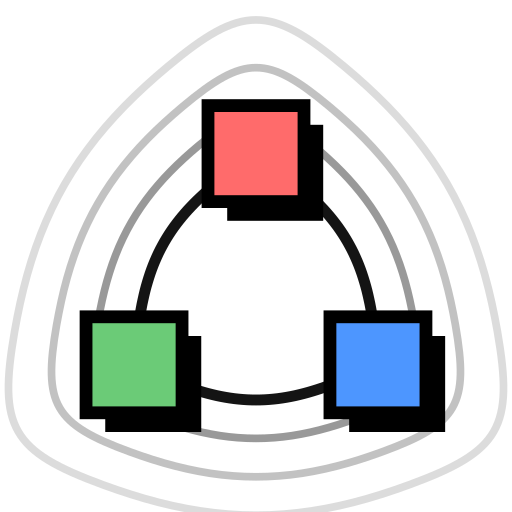
Foundations The visual language, the five building blocks, the central insight that distance is rhythm, the levels creators move between, and the principles behind theory, AI, tuning, and authorship. A second language for music Vibe Together gives every musical event a visible body. Pitch becomes hue, octave becomes brightness, and duration plus velocity shape the square articulation border. Signals cross wires and flash at the nodes where they sound. Five building blocks that make a graph A spatial composition is built from five ideas: Source, wire, node, modifier, and signal. It is a small alphabet with enough room for melody, rhythm, arrangement, and controlled mischief. Layout becomes timing The single biggest shift in spatial composition is that wire travel time is musical time. Move a node and the rhythm changes, not metaphorically, literally, because the signal takes longer to arrive. Three timing modes give you control over how layout maps to time. Composing at five levels Spatial composition is not one activity but a stack of activities. A creator can work at the tick level, the topology level, the agent level, the modifier-chain level, or the song-structure level, and most interesting compositions move fluidly between several. Knowing which level you are operating at is half of knowing what to do next. Bridges to traditional music theory Spatial composition extends, departs from, and occasionally refuses traditional Western music theory. Here is where the analogy holds and where it breaks, useful both for musicians arriving with a theory background and for educators considering whether this fits a music curriculum. We must make aesthetic choices, not AI. Vibe Together is not interested in prompt-to-song AI technology. We are exploring ways to use technology to aid the player but never replace them in the creative process. The aesthetic decision, the subjective call, and the final shape of a song should stay in human hands. AI can help the artist explore ideas they care about but should not generate a piece. We cannot prompt our creativity away. Nodal Graph/network-based generative composition with musical agents moving through user-defined nodes and edges. Orca ASCII-on-a-grid livecoded sequencer; instructions walk through a square producing generative MIDI patterns. Midinous Node-based MIDI sequencer where signals walk a graph of points and connections to produce evolving patterns. Ableton Live Session View Non-linear clip launching and idea exploration outside a fixed left-to-right timeline. Max Visual patching for sound, sequencing, modulation, and custom interactive music systems. Pure Data Open visual programming environment for generating sound, MIDI, video, graphics, and interactive systems. Reaktor Visual modular environment for building instruments and effects from primitive blocks; the patch is the program. Reactable Tangible modular music interface that makes electronic music structure spatial and directly manipulable. Tidal Cycles Livecoded procedural music language; short patterns of code produce continuously evolving rhythmic and melodic material. Sonic Pi Livecoded procedural composition aimed at education; algorithmic music as a teaching surface.