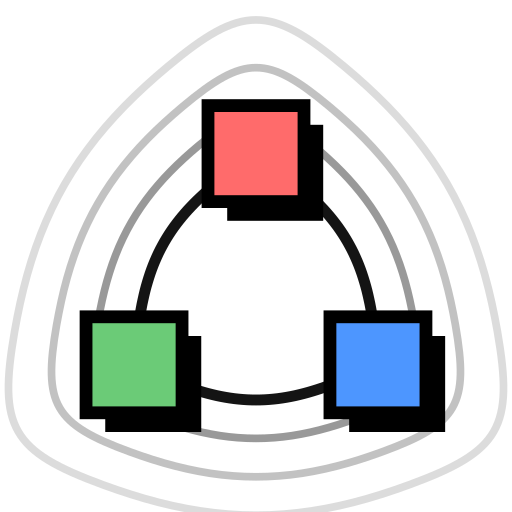
Layout becomes timing
The single biggest shift in spatial composition is that wire travel time is musical time. Move a node and the rhythm changes, not metaphorically, literally, because the signal takes longer to arrive. Three timing modes give you control over how layout maps to time.
In a normal sequencer the timeline is a number line and notes are points on it. To change a rhythm, you click events and drag them. In spatial composition the timeline is gone. Rhythm comes from how long signals take to walk between objects, and that walk is something you sketch with your hands. The grid is the score, and moving a node is the same gesture as moving an event.
Distance mode
The default. Every grid cell is one tick, and at 120 BPM with four steps per beat, one tick is 125 milliseconds. A four-cell wire is therefore a 500 ms delay: half a second, or one beat. Slide the destination node one cell further away, and the signal arrives one tick later. Slide it three cells closer, and the rhythm tightens up. You shape the groove by shaping the layout.
Beat mode
When the groove needs exact musical values, such as a clean half-beat answer, a triplet against a straight line, or a deliberate two-bar lag, a wire can lock to fractional or whole beats. Beat-mode wires ignore the grid distance entirely; they always wait the same musical amount regardless of where you have placed the nodes. Useful for polyrhythms, for keeping a counter-melody on a strict subdivision, or for letting yourself rearrange the layout for visual reasons without breaking the rhythm.
Millisecond mode
Sometimes the right delay is a number that does not divide evenly into beats: a slap-back echo at 87 ms, a doubled-voice answer at 23 ms for a chorusing effect, a long ambient tail at 2.5 seconds. Millisecond mode gives a wire an exact delay in audio time, independent of tempo. Like the delay control on a guitar pedal, but per-wire and visible in the layout.
Why this changes how you compose
When layout is timing, three things stop being separate problems. Arranging and rhythm become the same activity: you are not composing a melody and then deciding where it sits, you are composing a placement and the rhythm is what falls out. Editing becomes manipulation: moving things on a grid feels physical in a way clicking events on a timeline never does. Improvisation becomes possible at the structural level: you can rearrange the arrangement live by dragging nodes, and a player or collaborator can do the same.
It also changes what learning music creation feels like. A student who has not yet internalized that "an eighth note is a length" can still understand "this thing is closer than that thing, so it gets there sooner." The rhythm vocabulary is built from a physical metaphor that everyone already has.