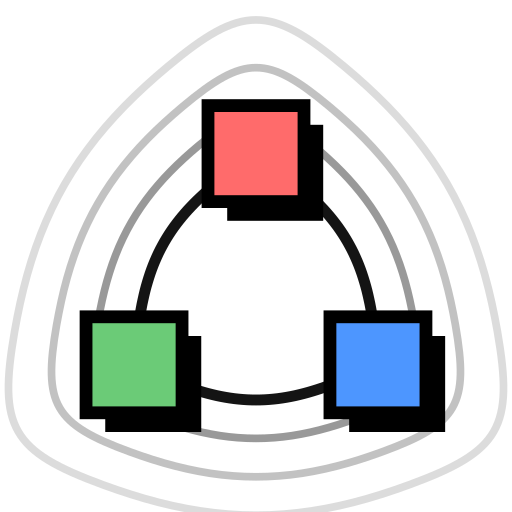
Five building blocks that make a graph
A spatial composition is built from five ideas: Source, wire, node, modifier, and signal. It is a small alphabet with enough room for melody, rhythm, arrangement, and controlled mischief.
Spatial composition starts with five ideas, each with one job. Learn the alphabet first. The depth lives in how those pieces combine.
Source: where signals begin
A Source is the only object that creates signals. It can fire every measure, at a chord change, on a section boundary, or at its own interval. Each Source carries an instrument, a procedural preset (bass, melody, harmony, rhythm, lead, or percussion), and an output mode for internal audio or external MIDI. No Source, no signal. No signal, no party.
Wire: route plus timing
A wire is more than a connection. It is also a delay. Every wire has a travel time, and that travel time is musical: it determines when the downstream object hears the signal. Three timing modes give you control: distance (grid cells = ticks), beats (snap to musical time), and milliseconds (exact delay). Move a node, the wire grows longer, the rhythm changes.
The full deep dive on how layout becomes timing. Continue learning
Node: the destination
A node is a place where a signal becomes sound. Vibe Nodes resolve one note, using a Source's procedural pitch or a manual override. Chord Nodes sound several notes with configurable voicing, inversion, and arpeggiation. Sample Nodes play a clip from an upload, microphone recording, generation, or library. Mute any of them to keep the structure while silencing the result.
Modifier: the transform
Modifiers are inline transforms: a signal enters, something happens, and one or more signals leave. Splitters can send to all branches, alternate round-robin, use weights, or test independent probabilities. Gates delay or filter by timing rules. Harmony offers 17 pitch transforms. Modulators swap the procedural role mid-graph. Sample Nodes live in the modifier family internally, but behave as playable destinations in the interface.
Signal: the thing that moves
A signal is the thing that moves. A Source creates it, a wire carries it, modifiers can transform or copy it, and a node turns its arrival into sound. It carries musical context—pitch, velocity, duration, and procedural state—plus the route it has travelled. Signals can split, recombine, and loop, with a feedback budget preventing runaway cycles.
How they combine
A minimal graph needs a Source, a wire, and a node. Put a modifier in the middle and the graph starts changing its own material. Add a Splitter for parallel voices. Add a bounded feedback loop and it can keep developing. Instruments, presets, audio reactivity, multiplayer, and publishing sit on top of that small grammar.