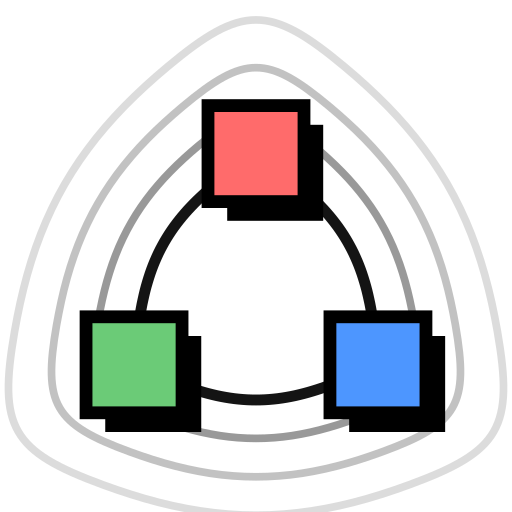
Controlled feedback
Cycles in a graph would normally run forever. The 16-repeat feedback budget turns them into a creative tool: feedback loops produce evolving material until they fade out, while one-way phrases can keep moving through the graph.
Connect a node back to one of its upstream neighbors and you have a cycle. A signal arriving at the loop entry will travel around the loop again, again, again. Without a stop condition, this would run indefinitely. Each Source wave admits every distinct node and wire once, then shares a 16-repeat node budget and a 16-repeat wire budget across all of its branches.
The move
- Place a Source and a Vibe Node. Connect them.
- Place a harmony modifier (octaveDown) and a second vibe node downstream.
- Connect the second vibe node back to the harmony modifier with a long wire (8+ cells).
- You now have a cycle: Source → Vibe → Harmony → Vibe → Harmony → Vibe → … dropping an octave on each pass.
- Listen. Each loop drops an octave. After ~3-4 repeated hops the signal is in the bass; after ~8 repeated hops it bottoms out in the lowest octave (clamped). The loop stops when the feedback budget is spent.
What the budget gives you
Sixteen repeated node arrivals and wire traversals per Source wave is enough for arpeggiated cycles, descending or ascending stacks, recursive call-and-response, and decay-style ornaments. It is too few for runaway. Designers can compose with the limit: the way it forces eventual termination is part of the aesthetic. A cycle that fades feels intentional; an infinite cycle would feel broken.